
[MD.phD.] Procalcitonin (PCT) Test
Procalcitonin (PCT) Test: A Specialist’s Complete Guide to Sepsis Diagnosis and Antibiotic Stewardship
By Laboratory Medicine Specialist, MD.phD.
Quick summary: Procalcitonin (PCT) is a blood biomarker that rises sharply and specifically in bacterial infections and sepsis, while remaining low in viral illnesses — making it one of the most clinically valuable tools for guiding antibiotic decisions and monitoring treatment response. This article covers what PCT is, how it is measured using CMIA technology, reference ranges, clinical interpretation, and the critical limitations every clinician and informed patient should understand.
1. What is procalcitonin and why is this test ordered?
Procalcitonin is the precursor peptide of calcitonin, normally produced in trace amounts by thyroid C cells. During severe bacterial infection, however, virtually every parenchymal cell in the body is stimulated — via bacterial endotoxins and pro-inflammatory mediators — to produce PCT in large quantities. This systemic release is what makes PCT a powerful signal specifically for bacterial disease.
Critically, interferons released during viral infections actively suppress PCT production. This biological mechanism is why PCT remains near-normal during most viral illnesses, giving it a key advantage over non-specific markers like CRP or white blood cell count.
1–3 h Rise begins after bacterial trigger
6–12 h Peak concentration reached
~24 h Half-life — falls quickly with treatment
Key clinical indications
- Diagnosing and risk-stratifying bacterial sepsis and septic shock
- Differentiating bacterial from viral pneumonia, meningitis, or UTI
- Guiding antibiotic initiation and safe de-escalation (antibiotic stewardship)
- Monitoring treatment response in ICU and hospitalized patients
- Evaluating post-operative patients for infectious complications
2. How the test is performed: CMIA technology
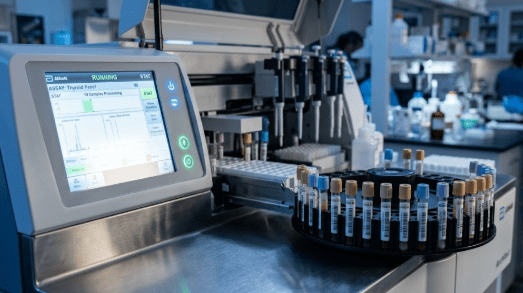
The current standard for PCT measurement in clinical laboratories is Chemiluminescent Microparticle Immunoassay (CMIA), available on platforms such as Abbott Architect and Roche cobas. This fully automated method delivers results rapidly with excellent sensitivity and reproducibility.
How CMIA works
Magnetic microparticles coated with anti-PCT antibodies capture PCT from the patient’s serum. A chemiluminescent label then emits light proportional to the amount of PCT bound — the instrument converts this signal to a precise concentration.
Advantages of CMIA
High analytical sensitivity (<0.05 ng/mL detection limit), rapid turnaround time suitable for emergency settings, low inter-assay variability, and full automation reducing human error.
3. Reference ranges and clinical thresholds
The table below represents widely accepted clinical decision thresholds. Always apply your own laboratory’s validated reference interval when interpreting patient results.
| Level | PCT Range | Unit | Clinical Interpretation |
|---|---|---|---|
| Normal | < 0.05 – 0.10 | ng/mL | Bacterial infection unlikely; consider viral etiology |
| Low suspicion | 0.10 – 0.25 | ng/mL | Low probability; monitor clinically, repeat if deterioration |
| Borderline | 0.25 – 0.50 | ng/mL | Possible localized bacterial infection; clinical correlation required |
| Elevated | 0.50 – 2.0 | ng/mL | Bacterial infection likely; consider antibiotic therapy |
| High — sepsis | 2.0 – 10.0+ | ng/mL | Sepsis or severe infection; prompt intervention required |
| Critical | > 10.0 | ng/mL | Septic shock, high mortality risk; aggressive management |
* Reference ranges may vary by laboratory and clinical platform. Interpret results alongside full clinical context.
4. Clinical interpretation
Elevated PCT — conditions associated with increased levels
PCT rises in two main categories: true bacterial infection, and severe non-infectious physiological stress. Distinguishing between these is clinically essential.
Bacterial / infectious causes
- Bacterial pneumonia
- Sepsis and septic shock
- Acute pyelonephritis
- Intra-abdominal infections
- Bacterial meningitis
- Endocarditis
Non-infectious causes (important)
- Major surgery (especially cardiac)
- Severe trauma or burns
- Cardiogenic or hemorrhagic shock
- Solid organ transplantation (early post-op)
- Acute kidney injury (mild elevation only)
Key mechanism note: In non-infectious conditions, PCT elevation is typically moderate (<2–5 ng/mL), transient, and follows a predictable downward trend. A persistently high or rising PCT in a post-surgical patient should raise strong suspicion for a superimposed bacterial infection.
Low or normal PCT — what it tells us
- Viral infections (influenza, RSV, COVID-19, adenovirus) — interferon-gamma actively suppresses PCT synthesis; values typically remain below 0.25 ng/mL
- Effective antibiotic treatment — PCT falls by roughly 50% every 24 hours with good therapeutic response, making it an excellent monitoring tool
- Immunosuppressed patients — corticosteroids and immunosuppressants may blunt the PCT response; a “normal” value in this group does not exclude serious infection
- Localized bacterial infections (e.g., uncomplicated skin abscess) — PCT may remain low in the absence of systemic spread
5. Precautions and limitations
Important: PCT is a highly useful adjunct biomarker — it is not a standalone diagnostic test. Clinical judgment, imaging, cultures, and other laboratory findings must always guide the final decision.
- Renal impairment: Reduced PCT clearance in chronic kidney disease can cause mild background elevation. In these patients, a single absolute value is less reliable than a serial trend. A sharp rise from the patient’s individual baseline remains clinically meaningful.
- Post-operative state: Major surgery triggers a physiological PCT rise that peaks around 24 hours and should normalize within 48–72 hours. Failure to normalize, or a secondary rise, is a red flag for surgical site infection or anastomotic leak.
- COVID-19 and viral co-infections: PCT is usually low in uncomplicated COVID-19; however, secondary bacterial pneumonia — a common and dangerous complication — elevates PCT significantly and should prompt antibiotic consideration.
- Antibiotic stewardship caution: Do not withhold antibiotics from a critically ill patient solely because PCT is low. Conversely, a rising PCT in a treated patient strongly argues against antibiotic de-escalation.
- Assay platform variability: PCT values are not perfectly interchangeable between platforms (e.g., Roche vs. Abbott). Whenever possible, serial measurements in the same patient should be performed on the same instrument.
- Self-diagnosis risk: PCT values must never be interpreted without professional clinical context. A result labeled “elevated” on a lab report does not automatically mean sepsis — and a “normal” value does not rule out early or localized infection.
6. Specialist’s perspective
In my experience in the laboratory and at the clinical interface, procalcitonin is most powerful when used dynamically — not as a one-time snapshot, but as a trajectory. A PCT of 8 ng/mL falling to 3 ng/mL within 48 hours of antibiotic initiation tells me the patient is responding. That same PCT of 8 ng/mL rising to 15 ng/mL tells me to urgently reconsider the source, the organism, or the chosen antibiotic.
The most meaningful clinical application of PCT today is antibiotic stewardship — using falling PCT values to safely shorten antibiotic courses in proven bacterial infections. Multiple randomized trials, including those in NEJM and JAMA, have demonstrated that PCT-guided antibiotic de-escalation reduces antibiotic exposure without increasing mortality. This is not merely cost-saving — it is patient-protecting. Used alongside CRP, blood cultures, and clinical assessment, PCT helps clinicians make more confident, evidence-based decisions at some of the most critical moments in patient care.
Laboratory Medicine Specialist, MD.phD.
Board-certified specialist in Laboratory Medicine with clinical expertise in infection biomarkers, sepsis diagnostics, and immunoassay platforms. Focused on translating complex laboratory science into clear, evidence-based guidance for clinicians and informed patients worldwide.
[MD.phD.] CRP (C-Reactive Protein) Test – MedLab Insight
Some images in this post were generated using AI.
References
- Schuetz P, et al. Effect of PCT-guided antibiotic treatment on mortality in acute respiratory infections. JAMA. 2018;319(7):708–718.
- Christ-Crain M, Müller B. Procalcitonin in bacterial infections. Swiss Med Wkly. 2005;135:451–460.
- UpToDate. Procalcitonin use in adults with suspected infection. Wolters Kluwer. Accessed April 2026.
- Singer M, et al. The Third International Consensus Definitions for Sepsis (Sepsis-3). JAMA. 2016;315(8):801–810.
- Mayo Clinic Laboratories. Procalcitonin, Serum — Clinical and Interpretive. mayocliniclabs.com. Accessed April 2026.
- National Institutes of Health (NIH). MedlinePlus. Procalcitonin Test. medlineplus.gov. Accessed April 2026.
- Bouadma L, et al. Use of procalcitonin to reduce patients’ exposure to antibiotics in ICUs. Lancet. 2010;375(9713):463–474.
- https://pubmed.ncbi.nlm.nih.gov/26903338