How Hemolysis Affects Blood Test Results

How Hemolysis Affects Blood Test Results: A Laboratory Medicine Specialist’s Complete Guide
Written by a Laboratory Medicine Specialist (MD.phD.)
Introduction
As a Laboratory Medicine Specialist, one of the most common calls I make to clinical teams is: “We need a repeat draw — the specimen is hemolyzed.” Hemolysis, the rupture of red blood cells (RBCs) releasing their intracellular contents into the surrounding plasma or serum, is the single most frequent pre-analytical error in clinical laboratories worldwide. It matters enormously because it can artificially elevate or suppress a wide range of test values, leading to misdiagnosis, unnecessary investigations, and — in the worst cases — dangerous clinical decisions. This guide explains what hemolysis is, why it happens, which laboratory values it distorts, and what clinicians and patients need to know to prevent it.
What Is Hemolysis in the Context of Blood Testing?
Hemolysis literally means the destruction of red blood cells. Each RBC is a bag of highly concentrated intracellular compounds — potassium, enzymes, iron, phosphorus — that are maintained at concentrations far higher inside the cell than in the surrounding plasma. When the RBC membrane ruptures, all of these substances flood into the serum or plasma, contaminating the sample with material that does not belong there under normal physiological conditions.
Visually, a hemolyzed specimen is a giveaway: the serum or plasma turns pink to deep red, rather than its normal pale yellow color, due to the release of hemoglobin. Most modern laboratory analyzers can detect hemolysis automatically using a hemolysis index (HI), grading specimens from slight (H+) to severely hemolyzed (H+++).
Why Does the Laboratory Order a Repeat Draw?
When hemolysis is detected, a repeat blood draw is almost always required because:
- The analytical results no longer reflect the patient’s true physiological state
- Artifactual elevations or suppressions can mimic serious disease
- Clinical decisions based on hemolyzed specimens carry significant risk of patient harm
Why Does Hemolysis Occur? Causes & Classification
Understanding the root cause is essential — hemolysis is either an artifact of specimen collection and handling (in vitro hemolysis) or a true pathological process happening inside the patient (in vivo hemolysis).
In Vitro Hemolysis (Specimen Artifact) — Most Common
This accounts for the vast majority of hemolyzed specimens seen in routine outpatient and inpatient settings.
Collection technique errors:
- Withdrawing the syringe plunger too rapidly, creating excessive negative pressure that shears RBCs
- Using a needle gauge that is too small (e.g., 25G or smaller) for high-volume draws
- Poor venipuncture angle causing vessel wall trauma and turbulent blood flow
- Forcefully injecting blood from a syringe into a vacuum tube, rather than allowing passive fill
- Patient repetitively clenching and unclenching the fist during prolonged draws
Specimen handling errors:
- Vigorous shaking of collection tubes (tubes should only be gently inverted)
- Incorrect centrifugation speed or duration
- Excessive heat exposure, freezing, or thawing of specimens
- Prolonged transport with mechanical vibration
In Vivo Hemolysis (True Pathological Hemolysis) — Less Common
In a minority of cases, the hemolysis is genuine — the patient’s RBCs are actually being destroyed inside the body. Causes include:
- Autoimmune hemolytic anemia (warm or cold antibody type)
- Microangiopathic hemolytic anemia (TTP, HUS, DIC)
- Sepsis and bacterial toxins
- ABO-incompatible blood transfusion reaction
- Glucose-6-phosphate dehydrogenase (G6PD) deficiency
- Hereditary spherocytosis or other RBC membrane disorders
- Mechanical hemolysis from prosthetic heart valves
⚠️ When a specimen is flagged as hemolyzed, the laboratory specialist must consider whether the hemolysis is artifactual (requiring a repeat draw) or pathological (requiring urgent clinical evaluation). Clinical correlation is essential.
Reference: Hemolysis Index Grading
While individual test results do not have a single “reference range” for hemolysis, laboratories use a standardized Hemolysis Index (HI) to grade interference.
| Hemolysis Grade | Hemolysis Index (HI) | Approximate Free Hemoglobin | Clinical Action |
|---|---|---|---|
| None | < 20 | < 0.02 g/dL | Report results |
| Slight (H+) | 20–100 | 0.02–0.1 g/dL | Report with comment; flag affected analytes |
| Moderate (H++) | 100–200 | 0.1–0.2 g/dL | Flag; repeat draw recommended for critical analytes |
| Severe (H+++) | > 200 | > 0.2 g/dL | Repeat draw required; do not report affected values |
⚠️ Reference thresholds and grading scales may vary by laboratory and analyzer platform.
How Hemolysis Distorts Blood Test Results
This is the heart of the matter. The impact of hemolysis is analyte-specific — some values are spuriously elevated, others are falsely suppressed, and a few are relatively unaffected.
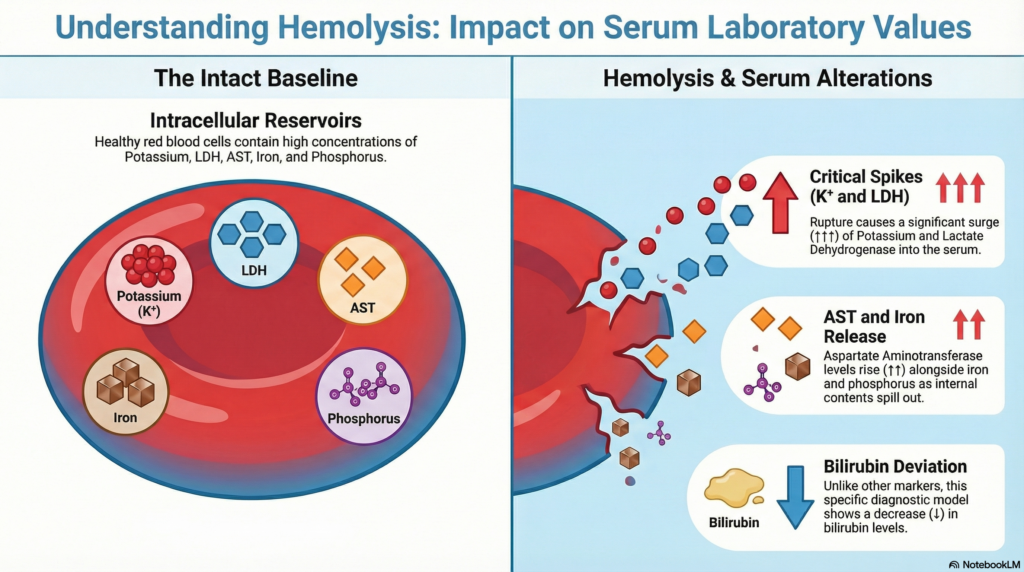
Analytes That Are Spuriously Elevated by Hemolysis
The following test values are artificially increased when hemolysis occurs, because the analyte is highly concentrated inside RBCs and is released into the serum upon cell rupture.
Potassium (K⁺) — Most Clinically Dangerous The intracellular potassium concentration in RBCs is approximately 100 mEq/L, versus only 3.5–5.0 mEq/L in plasma. Even mild hemolysis can raise the measured serum potassium by 0.5–1.0 mEq/L; severe hemolysis can push it above 7–8 mEq/L. This produces pseudohyperkalemia — a falsely elevated potassium reading — which can prompt clinicians to initiate emergent treatment (e.g., calcium gluconate, insulin-dextrose, sodium bicarbonate) in a patient who is completely normokalemic. This is perhaps the single most dangerous consequence of unreported hemolysis.
Lactate Dehydrogenase (LDH) LDH is present at extremely high concentrations inside RBCs — roughly 160 times higher than in plasma. Hemolysis causes dramatic, disproportionate elevations in LDH that dwarf any pathological rise due to myocardial infarction, liver disease, or hemolytic anemia. LDH is one of the most sensitive markers of hemolysis.
AST (Aspartate Aminotransferase) RBCs contain significant quantities of AST. Hemolysis elevates AST more than ALT, which is a useful diagnostic clue — a hemolyzed specimen showing an elevated AST/ALT ratio without a corresponding rise in ALT or other liver injury markers should prompt suspicion of hemolytic interference rather than true hepatocellular disease.
ALT (Alanine Aminotransferase) Also elevated, but typically less dramatically than AST, because RBCs contain proportionally less ALT than AST.
Iron (Fe) Intracellular iron from hemoglobin degradation is released into the serum, artificially elevating serum iron measurements. This can confound the interpretation of iron deficiency or iron overload workups.
Inorganic Phosphorus (PO₄³⁻) RBCs contain high concentrations of organic phosphate compounds. When cells lyse, enzymatic hydrolysis releases inorganic phosphate into the serum, spuriously raising phosphorus levels — a phenomenon that can mimic hyperphosphatemia.
Total Protein Intracellular proteins released from lysed RBCs contribute to a modest increase in total protein measurements.
Magnesium (Mg²⁺) and Creatine Kinase (CK) Both can be mildly elevated due to intracellular release, though the effect is generally less pronounced than for potassium or LDH.
| Analyte | Direction of Change | Mechanism | Clinical Risk |
|---|---|---|---|
| Potassium (K⁺) | ↑↑↑ Marked increase | Intracellular [K⁺] ~100 mEq/L vs plasma ~4 mEq/L | Pseudohyperkalemia → dangerous treatment |
| LDH | ↑↑↑ Marked increase | RBC [LDH] ~160× plasma concentration | False MI/hemolysis diagnosis |
| AST | ↑↑ Moderate increase | Significant RBC AST content | Misdiagnosis of liver disease |
| Iron | ↑ Mild–moderate | Hemoglobin-derived intracellular iron | Confounds iron studies |
| Inorganic Phosphorus | ↑ Mild–moderate | Phosphate release from RBC metabolism | False hyperphosphatemia |
| Total Protein | ↑ Mild | Intracellular protein release | Minor clinical impact |
| ALT | ↑ Mild | Lower RBC ALT vs AST | Usually less dramatic than AST |
| Magnesium | ↑ Mild | Intracellular magnesium release | Minor clinical impact |
| Creatine Kinase (CK) | ↑ Mild | Intracellular release | Minor clinical impact |
Analytes That Are Spuriously Decreased by Hemolysis
Total Bilirubin This is the most clinically relevant analyte that is falsely lowered by hemolysis. Free hemoglobin in the serum absorbs light at wavelengths overlapping with bilirubin’s spectrophotometric measurement, causing optical interference that results in a falsely low bilirubin reading. This is particularly concerning in neonates, where accurate bilirubin measurement is critical for assessing the risk of kernicterus.
Other Optically Measured Analytes Several other analytes measured by colorimetric or spectrophotometric methods can be affected by the intense color imparted by free hemoglobin, generally resulting in falsely low readings. These include certain lipid fractions and some enzyme assays, depending on the reagent and wavelength used.
Precautions & Limitations
Preventing hemolysis at the point of collection is a shared responsibility of phlebotomists, nurses, and physicians:
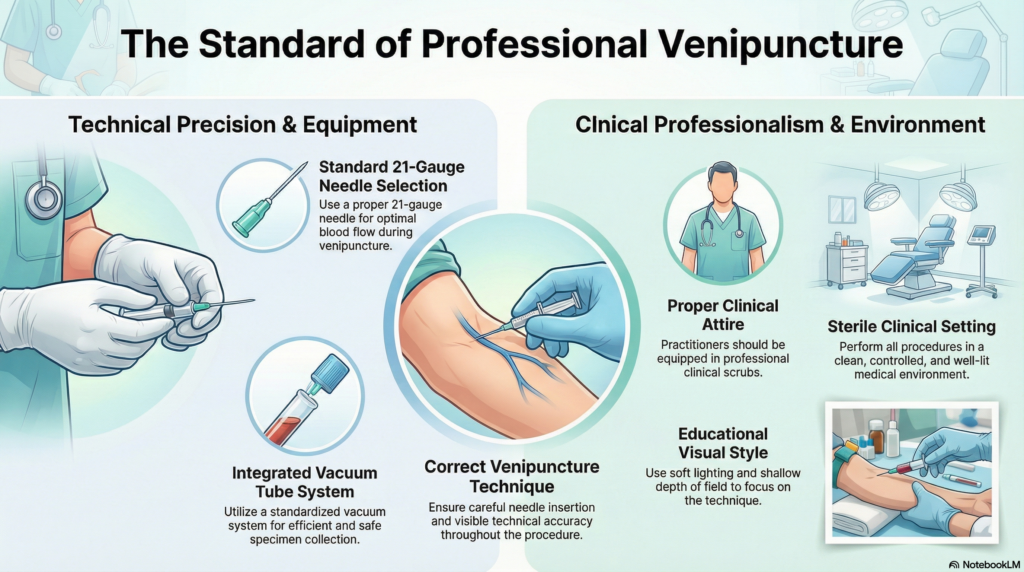
- Use appropriately sized needles — 21G or 22G for most adult venipuncture
- Allow antiseptic to dry fully before needle insertion to prevent RBC osmotic stress
- Avoid drawing from sites with active IV infusions
- Fill vacuum tubes passively — never inject under pressure
- Gently invert (do not shake) tubes 5–10 times after collection
- Ensure timely, temperature-appropriate transport to the laboratory
Limitations in interpretation:
- The hemolysis index does not distinguish in vitro from in vivo hemolysis — clinical context is always required
- Some analytes (e.g., glucose, sodium, chloride, creatinine) are relatively unaffected by hemolysis, while others (potassium, LDH) are exquisitely sensitive
- Even low-grade, visually undetectable hemolysis can meaningfully elevate potassium in specimens stored at room temperature for more than 30 minutes, as RBCs continue to leak potassium post-collection
- A hemolyzed result should never be used in isolation for clinical decision-making. Always correlate with the patient’s clinical presentation, ECG findings, and repeat specimen results
Specialist’s Perspective & Conclusion
In laboratory medicine, we often say that a test result is only as good as the specimen it comes from. Hemolysis is a perfect illustration of this principle. In my practice, the cases that concern me most are not the obviously deep-red hemolyzed specimens that trigger automatic rejection — it is the mildly hemolyzed samples with a hemolysis index of 50–80 that slip through with a cautionary comment, and whose potassium or LDH values are then acted upon without the clinician appreciating the degree of interference.
My practical advice to clinical colleagues:
- Never treat a potassium of 6.0 mEq/L without first checking the hemolysis index. Pseudohyperkalemia from hemolysis is one of the most preventable causes of iatrogenic harm in medicine.
- An isolated LDH elevation in a hemolyzed specimen means nothing diagnostically — it must be repeated in a clean sample.
- When bilirubin is unexpectedly low in a jaundiced patient or neonate, consider hemolytic interference before concluding the level is truly normal.
- Invest in phlebotomy training. Studies consistently show that trained, dedicated phlebotomists produce significantly lower hemolysis rates than nurses or physicians drawing blood as a secondary task.
The bottom line: hemolysis is not merely an inconvenience that delays results. It is a patient safety issue. Recognizing hemolyzed specimens, understanding which analytes are affected and in which direction, and ensuring repeat draws are completed promptly are core competencies in safe laboratory practice.
Author Profile
This article was authored by a board-certified Laboratory Medicine Specialist (MD.phD.) with subspecialty training in clinical chemistry and pre-analytical quality management. The author has served as a consultant in transfusion medicine and laboratory diagnostics at a university hospital, with a focus on specimen quality improvement and reducing diagnostic error from pre-analytical variables.
Weak D Test: Interpretation by medical doctor – MedLab Insight
References
- Lippi, G., Cervellin, G., & Mattiuzzi, C. (2013). Critical review and meta-analysis of spurious hemolysis in ED samples. Clinical Biochemistry, 46(14), 1267–1272. https://doi.org/10.1016/j.clinbiochem.2013.05.016
- Lippi, G., Salvagno, G. L., Montagnana, M., Lima-Oliveira, G., Guidi, G. C., & Favaloro, E. J. (2011). Quality standards for sample collection in coagulation testing. Seminars in Thrombosis and Hemostasis, 38(6), 565–575.
- Clinical and Laboratory Standards Institute (CLSI). (2018). Hemolysis, Icterus, and Lipemia/Turbidity Indices as Indicators of Interference in Clinical Laboratory Analysis: Approved Guideline (EP7-A2). CLSI.
- Braga, F., & Panteghini, M. (2016). Generation of permissible limits for acceptable agreement between in vitro diagnostic examinations. Clinical Chemistry and Laboratory Medicine, 54(7), 1069–1076. https://doi.org/10.1515/cclm-2015-1201
- Carraro, P., & Plebani, M. (2007). Errors in a stat laboratory: Types and frequencies 10 years later. Clinical Chemistry, 53(7), 1338–1342. https://doi.org/10.1373/clinchem.2007.088344
- Plebani, M., & Lippi, G. (2010). Improving quality in pre-analytical phase. Clinical Chemistry and Laboratory Medicine, 48(7), 913–914.
- Burns, E. R., & Yoshikawa, N. (2002). Hemolysis in serum samples drawn by emergency department personnel versus laboratory phlebotomists. Laboratory Medicine, 33(5), 378–380.